Ben Moon: The Story of a Legendary British Climber
Ben Moon , British climbing legend, raised the world bar to 9a with the Hubble route and is remembered for other Iconic feats such as Statement of Youth and Agincourt . A pioneer of redpoint climbing in the UK, he...
Published · 23 min read

Contents · 6
- Introduction
- The Beginnings in the 1980s: Statement of Youth and the Sport Climbing Revolution
- Towards 9a: Hubble and the Limit of Possibilities
- From the Cliff to the Rocks: The Bouldering Turning Point and the 1990s
- The Temporary Retirement and the Return of the Champion (2010s)
- Ben Moon's Legacy: Coaching, Innovation, and Collaborations
Introduction
Ben Moon is universally recognized as one of the pioneers and key innovators of sport climbing and bouldering. In the space of a decade (the 1980s and 1990s), he raised the world bar from 8a to 8c+/9a, leaving an indelible mark with landmark first ascents such as Statement of Youth, Agincourt, and Hubble. His "second life" as a boulderer and his achievements into his 40s and 50s demonstrate an extraordinary passion and longevity. At the same time, with the founding of Moon Climbing and the invention of the MoonBoard, he helped shape the way climbers train and progress. Today, Ben Moon remains active in the community, whether pursuing an old dream like Northern Lights, running his own company, or sharing his experience through interviews and writing. His name is synonymous with an era and a style of climbing: one in which determination and a love of “movement” (as he himself said in his youth: “I don’t climb to be in beautiful places… I climb for the movement, man!”) have transcended known limits and inspired generations of climbers around the world.
Childhood and Education: First Steps in the Lake District
Ben Moon was born in 1966 in England to a wealthy family and grew up in the south of the country. From an early age, he developed a connection with nature: none of his family practiced climbing, but frequent holidays in the mountains and cliffs instilled in him a passion for the outdoors.
At just 7 years old he tried climbing for the first time, on some rocks in the Lake District during a family trip, and was immediately fascinated by the verticality.
Family
Ben's childhood was also marked by a tragic event : his father Jeremy, a professional artist, died in a motorcycle accident when Ben was just six years old.
Raised by his mother Elizabeth, Ben attended Christ's Hospital School , where he developed a nonconformist character (his image as a thin, pale, rebellious young man with dreadlocks is famous) which he soon channeled into climbing.
Sheffield and the 80s scene
At 16 , Ben made a crucial decision: he dropped out of school and moved to Sheffield , Yorkshire, considered the mecca of British climbing.
It's the early 1980s , and Sheffield, with its surrounding limestone and granite crags, is the epicenter of a new generation of climbers. To fully dedicate himself to climbing, Ben initially lives on unemployment benefits ("on the dole") and shares a spartan lifestyle with other climbers determined to climb full-time.
Meeting with Jerry Moffatt
In this environment he met and became friends with Jerry Moffatt , a British champion a few years older than him: the two soon became climbing and training partners, forming a legendary duo on the scene of the time.
From trad to sport climbing
Initially Moon tackled traditional routes (climbing with trad gear) and climbed up to the British grade E7 , but soon his horizons change.
A trip to France in the early 1980s with Moffatt, at the time at the forefront of the nascent sport climbing, opened his eyes to the potential of sport climbing.
In Buoux and Verdon, the two witnessed the French methods: bolted routes, worked with repeated attempts ( yo-yo and redpoint ) to climb them without falls. Back home, Ben and Jerry began applying these innovative techniques to English crags as well, breaking with the purist British tradition and quickly pushing the bar higher.
The redpoint revolution in the UK
Thus was born the redpoint " revolution " in the UK: instead of settling for short, sporadic yo-yo attempts, Moon adopted a systematic approach to projects, attempting them repeatedly until he successfully linked them in a complete freestyle (worked). This mentality, pioneering for the UK, contributed to the British grade's progress year after year.
First competitions
During the second half of the 1980s, he also participated in the first sport climbing competitions , although the competitive scene was still in its infancy. He made his debut in 1986 in Bardonecchia , Italy, in one of the first international competitions (SportRoccia), and continued to compete for about seven years.
He mainly takes part in difficult competitions (bouldering competitions will come later) and, although he enjoys it, he admits that he has never felt completely satisfied with his results in competitions, which are far inferior to his performances on rock.
Nonetheless, these experiences helped make his name known in the climbing community and fueled his determination to push the limits of outdoor climbing.
The Beginnings in the 1980s: Statement of Youth and the Sport Climbing Revolution
Statement of Youth (1984)
1984 is the year Ben Moon leaps into the climbing spotlight . Aged eighteen, skinny and with shoulder-length dreadlocks, he makes the first ascent of Statement of Youth at Lower Pen Trwyn, a seaside limestone crag in North Wales.
It's an 8a route that Moon entirely bolted and freed with bolt protection, a first for the United Kingdom at the time, which was still tied to ethics and traditional protection. Statement of Youth is recognized as a milestone : at the time, it was only the second British 8a and one of the very first fully sport climbs in the UK.
A manifesto and the revolution
It is precisely thanks to this “manifesto” route (the name itself is programmatic) that Moon effectively launched the sport climbing revolution in Great Britain .
The ascent of Statement, in terms of difficulty and style, appears revolutionary: the message is clear: the era of sport climbing has begun across the Channel, too. Despite initial controversy among traditionalist climbers, the route became a highly sought-after classic, and is still considered a benchmark for British climbers of 8a today.
Moon himself proudly remembers this route, not so much for its extreme difficulty but because it is “ a beautiful line, with a great history, the one that everyone wants to climb if they climb 8a in the UK” .
Buoux and confrontation with the world elite
In the wake of this success, towards the end of the 1980s Ben Moon intensified his travels to continental Europe to test himself against the world's top climbers of the time. In particular, he frequented the crag of Buoux in Provence, then a hub of sport climbing, where he encountered French legends like the Le Menestrel brothers and Patrick Edlinger .
In 1988 he repeated in quick succession three of the hardest routes in Buoux and in the world: La Rage de Vivre , Le Minimum and Le Spectre du Sur Mutant , all graded 8b+ .
Agincourt and Maginot Line
These repeats showed that the young Englishman was now at the level of the best and prepared him for the next step: establishing routes at the highest level of difficulty. In November 1988, during his stay in Buoux, Moon set his sights on an old aid project on the overhanging slab of Les Dévers . Some Frenchmen had already attempted to free it, with a few bolts already in place, but without success.
Ben decides to give it a try: in about 12 days of work he finds the key by moving slightly to the left of the original line and, returning to the site in January 1989 , he finally manages to link the entire route.
Thus was born Agincourt , the first 8c route in France .
The patriotic name (referring to the battle won by the English against the French in 1415) is ironic but significant: Moon, a Briton on French soil, achieved a historic feat. Agincourt was immediately recognized as one of the hardest routes on the planet: up until that point, only Wolfgang Güllich in Germany had climbed 8c with Wallstreet (Frankenjura, 1987), making Moon's 8c the pinnacle of the era.
Moon himself recalls that it took him a couple of weeks in total to free it, a time that today would seem short for a project of such extreme difficulty (like doing a hypothetical 9c in two weeks), but which at the time seemed very long to him.
In fact, by today's standards, it's impressive how quickly Ben could send extremely hard routes, a sign of his great talent and the fact that those routes suited his powerful climbing style well. Shortly after Agincourt, again in 1989, Moon made another first ascent of 8c in France: Maginot Line (also known as Le Plafond) at the Volx crag.
Having established two 8c's in just a few months places Ben Moon at the top of the world rankings at the moment and confirms his reputation as a top climber.
Towards 9a: Hubble and the Limit of Possibilities
Hubble (1990)
In early 1990, at just 24 years old, Ben Moon accomplished the feat that was perhaps more destined than any other to consign him to climbing history. Returning home, he identified a short overhanging roof at Raven Tor (Peak District, England) and made the first ascent in June 1990, naming the route Hubble .
From the very beginning, Hubble was celebrated as the hardest route ever climbed up to that time . Moon himself, although he sensed that he had raised the bar, graded it 8c+ – preferring not to risk a jump of two grades from the previous maximum (8c).
Is Hubble the first 9a?
However, in the following years Hubble's reputation grew further : the route saw very few repetitions (just 6 in the first 30 years!) and was attempted in vain even by many of the world's strongest climbers.
Over time, a growing consensus has formed around the idea that Hubble's actual difficulty is actually 9a .
Even the phenomenon Adam Ondra , after trying Hubble, declared that it seemed in line with, if not more challenging than, Action Directe , the famous 9a freed by Güllich in 1991 in the Frankenjura and recognized for years as the "first 9a in the world." If Hubble is considered 9a, then it, not Action Directe, would be the first route of that grade in history, predating the conquest of 9a by a year.
In fact, as has been noted, Ben Moon would have made an extraordinary leap: from the first 8c (Wallstreet) directly to the first 9a, “skipping” the 8c+.
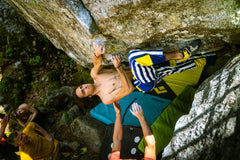
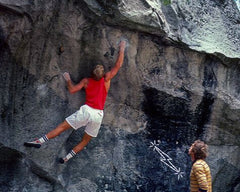
Ben Moon making the first ascent of Hubble at Raven Tor (1990), a route officially considered the world's first 8c+, but considered by many to be equivalent to a 9a.
Technical features
Hubble is a short route (around 8 metres) and extremely intense: in practice it consists of a block of 6 initial moves, estimated at around the grade 8B/8B+ Fontainebleau (V13/V14), followed by a final section of around 7c+ which, after the initial crux, is little more than a continuous exit.
It is precisely this bouldery nature that makes Hubble a peculiar route, one that foreshadowed the future limits of sport climbing at the time: a then-unprecedented level of pure strength was required to link those moves on the short initial section. Moon, gifted with great power, exploited these qualities to the full: incredibly, he needed only about ten days of total work to send the route (including just six days in the decisive season, 1990). This lightning-fast result likely contributed to his hesitation in proposing 9a: as he himself commented, " Jumping two grades didn't seem right... when you climb at the absolute limit, it's hard to understand how much that limit has shifted; if something feels harder than something else, it doesn't necessarily mean it's a whole grade harder; it might just be at the upper limit of that grade ."
So, prudently, he registered Hubble as 8c+. In hindsight , Moon recognizes that Hubble is “ definitely something more than an 8c+… another level,” and now even the guidebooks list it as 9a. From a technical point of view, Hubble was a masterpiece of reading and training . Ben went so far as to build a rudimentary panel in his cellar with holds that imitated, as best he could imagine, the route’s sequence, already intuiting its nature as an extreme “ boulder problem .”
In reality, the homemade mock-up turned out to be easier than the real thing and proved of little use , but it's indicative of the pioneering spirit with which Moon approached the project. In his testimony at the time, on the day of the ascent, he recounts falling once on the easy final section, out of surprise at having cleared the feared initial boulder problem, but finishing the climb the next day, well rested.
After Hubble
With Hubble, Ben Moon had signed his “ magnum opus ” in terms of pure difficulty (even if he personally considers Statement of Youth his most beloved route due to its historical significance). After this feat, the world scene looked at the British climber as one of the greatest protagonists of contemporary sport climbing . In the years immediately following, Moon continued to push himself to the highest levels. In 1991 he went to Germany to try Güllich's Action Directe (9a), curious to test himself with the new frontier and managed to send most of the moves, falling very high during the attempts on the link-up.
Unfortunately, a finger injury and the prohibitive weather conditions (cold and snow) prevented him from completing the project in those attempts, and subsequent relapses kept him away from attempting the route in the following years.
It remains significant, however, that Moon rated Action Directe “ difficult, for sure, but comparable in difficulty to Hubble .” A remarkable statement considering that AD is unanimously rated a full 9a. In 1993 , Ben added another piece to his list of notable first ascents: he returned to the crag of Lower Pen Trwyn, where he had taken his first steps almost ten years earlier, and made the first ascent of Sea of Tranquility 8c+ .
Once again, Moon pushed the limits in Britain, with what was one of the very first 8c+ routes in the UK. Around the same time, he also conceived an even more ambitious project : a very long route (about 50 meters) on the great overhang at Kilnsey , in Yorkshire. This infinite roof on the face known as the North Buttress became an obsession for Ben in the mid-1990s: he provisionally called it Northern Lights and dedicated about 30 days of attempts spread out over three seasons.
The route is extremely intense and requires resistance on micro-holds; Moon invested considerable physical and mental energy, but unfortunately suffered some injuries that ultimately forced him to abandon the project in 1996.
Northern Lights remained unrealized for him, and was then freed in 2000 by the very strong Englishman Steve McClure , who graded it 9a (Ben later joked that McClure found a slightly different sequence in one place, perhaps easier, but he still personally considers Northern Lights almost 9a+).
Years later, having returned to the crags, Moon would start trying it again, now exceeding 90-100 days of total work on what he defines as “ one of the most beautiful pitches I have ever been on ”, a true personal arché still pending.
From the Cliff to the Rocks: The Bouldering Turning Point and the 1990s
Film and media
After the mid-1990s, driven by frustration with the Kilnsey project, Ben Moon decided to take a break from long sport routes and focus his energies on bouldering . At that time, bouldering was emerging as a discipline in its own right, no longer just as a training ground for sport routes. Moon was among the protagonists of this paradigm shift: he devoted himself to bouldering with the same tenacity he had shown on his routes and contributed to raising the bar there as well, as well as promoting its media visibility.
In 1996 he and Jerry Moffatt, together with director Simon Tucker, made The Real Thing , the first feature-length bouldering film in history .
The cult film follows Moon, Moffatt, and other top climbers of the time (Sean Myles, Kurt Albert, Marc Le Menestrel) on a trip to Fontainebleau, the world's bouldering mecca, showcasing the passion and philosophy behind the discipline. For Moon and his companions, bouldering represents " the distilled essence of climbing ," and the film helps convey to a wider audience what motivates them on the boulders.
Besides The Real Thing, Moon also appears in other videos such as One Summer (another celebration of 90s bouldering), helping to establish the iconography of that nascent movement.
First boulder ascents
Alongside his media work, Ben made his mark with a series of first ascents of extreme boulder problems in Europe and the United States. Between the late 1990s and early 2000s, he established and sent numerous extremely difficult problems, often becoming classics. Here are some examples:
- Black Lung – Fb 8B (V13), Joe's Valley (USA): a short and powerful roof in Utah, freed by Moon in 1997, which became one of the iconic problems of Joe's Valley.
- 8-Ball – Fb 8A+ (V12), Gardom's Edge (England): a power boulder on gritstone in the Peak District, also climbed by Ben in those years.
- Cypher – Fb 8B (V13), Slip Stones (England): Another Moon boulder problem on sharp micro-crimps in Yorkshire, which ranks among the hardest British problems of the time.
Moon doesn't shy away from prestigious repeats either: a prime example is The Ace (Fb 8B) in Stanage, Jerry Moffatt's legendary sit start on The Joker. In January 2005 , Ben managed to send The Ace , making it only the world's third ascent.
A few months later , in November 2005, he added another gem: he opened Voyager (Burbage North) by solving the stand start version of this boulder, graded 8B, on the first ascent.
But the pinnacle came the following year: in November 2006, Moon, now in his forties , gritted his teeth and also completed the sit-start version of Voyager , which thus became his toughest problem ever.
Moon himself will comment on his blog that it is “ definitely the hardest piece of climbing I have ever done” and estimates the grade at around 8B+ .
Voyager sit start is still considered one of the most challenging problems ever climbed on Peak District gritstone .
With this work, Ben Moon demonstrates that even over 40, one can still push one's limits, a concept that will return forcefully in the following decade.
The Temporary Retirement and the Return of the Champion (2010s)
Break and return
After an intense bouldering phase, in late 2006 Ben Moon began to feel his motivation for extreme climbing wane . Shortly after sending Voyager sit start, during a trip to the USA, he even managed to flash (solve on his first try) a V12 boulder problem (Diaphanous Sea, at Hueco Tanks), further confirmation of his incredible level. However, upon returning home, he confessed to feeling demotivated and wanting to prioritize family and personal affairs.
He thus decided to take a long break from climbing , leaving the spotlight of sports news. For nearly a decade, little was heard of Moon in terms of new ascents: he devoted himself to being a father (in the meantime, he had married and had a daughter) and to developing his climbing equipment company. Many thought he had finally "hung up his climbing shoes." But Moon had far from finished his climbing career. In 2015, at the age of 48 or 49 , Ben returned to the spotlight with an extraordinary achievement. He would later say that the spark was rekindled by the sight of a climber working on a route he himself had bolted years before but never sent: Rainshadow, a 9a in Malham Cove (Yorkshire) bolted by Steve McClure and freed by the latter in 2003.
Rainshadow and Evolution
Seeing someone trying those moves inspired Moon to get back into the game. So, after training hard to get back into shape, in June 2015 Ben Moon managed to repeat Rainshadow (9a) , making his fourth ascent overall.
The feat caused a huge sensation: a 9a achieved at almost fifty years of age , 25 years after his historic Hubble in 1990.
It's a result that demonstrates how passion and preparation can allow for exceptional performances even at an advanced age, and in a certain sense it closes a symbolic circle in Moon's career. But that's not all. In November 2018, at the age of 52 , Ben added one last (so far) prestigious chapter to his resume : he repeated Evolution (8c+) at Raven Tor.
This route is not a random choice: it is in fact a legendary pitch freed in 1995 by his lifelong friend, Jerry Moffatt.
Moon had attempted it several times over the course of more than two decades, starting in the 1990s, but had never managed to complete it . Finally, after about 100 days of work spread over more than 20 years, he managed to complete the circle and climb his old friend's route.
In the previous weeks he had also repeated Hajj (an 8c also at Raven Tor), demonstrating an exceptional state of form even in his fifties.
After having tamed Evolution, animated by the same tenacious spirit as before, he has even resumed investing energy in his unfinished business, the Northern Lights project in Kilnsey, which he continues to test himself on from time to time with unchanged passion.
These veteran feats further cemented Ben Moon's legend, highlighting a rare athletic longevity. In an interview during those years, when asked how he saw the evolution of climbing, Ben enthusiastically responded to the inclusion of climbing in the 2020 Tokyo Olympics (a dream organizers had been nurturing for 30 years) and joked that " if I were younger, I'd be super excited to try to qualify and compete! " A sign that his competitive spirit has never left him.
Ben Moon's Legacy: Coaching, Innovation, and Collaborations
Jerry's Cellar and the Culture of Workout
Beyond his long list of rock accomplishments, Ben Moon's impact on climbing can also be measured in terms of training innovation and contributions to the sport's movement . Since the 1980s, Ben and his teammates had understood the importance of training for strength and endurance away from the crag. Following the example of Wolfgang Güllich (inventor of the campus board in Germany), a vibrant "artisanal" indoor training scene developed in Sheffield as well. A prime example was Jerry's Cellar: Jerry Moffatt's cellar, equipped with wooden beams and holds, where Jerry, Ben, and others would gather for intense campus boarding and pull-ups in the mid-1980s.
In that tiny basement, some of the insights that allowed Moon and his partners to excel on routes like Hubble were born (not surprisingly, as we've seen, he himself attempted to recreate the crux on a home training board). That obscure but highly effective training culture was the prelude to a more organized initiative that arrived in the 1990s. In 1993 , Moon and a group of strong Sheffield-based climbers (including Moffatt himself, Malcolm Smith, Stuart Cameron, and led by Gavin Ellis) rented an unused classroom in an old primary school in Heeley and transformed it into a training gym dedicated to top climbers .
School Room (1993)
Thus was born the legendary School Room : a 9x9 metre room fitted out with slanted panels covered with small discarded handles and wooden strips for the campus.
In that secret laboratory, some of the most difficult indoor boulder problems in the world are conceived and solved (problems like Perky Pinky and Milk It, rated around 8B, were born right there).
For over a decade, the School Room was a training sanctuary , accessible only to a select few , and it represents an important part of the legacy of that era. Ben Moon was one of the project's key instigators, and that experience would lead to significant future developments. After closing with the School Room , in 2002 Ben decided to capitalize on his thirty years of experience by founding his own climbing brand . He had actually already attempted a first commercial venture in the 1990s, launching the clothing line S7 (named after the Sheffield postcode) specializing in bouldering clothing and crash pads, but that initiative did not have lasting success.
Moon Climbing (2002)
With greater experience, he founded Moon Climbing , a company dedicated to producing high-quality climbing equipment and clothing, designed according to his minimalist and functional philosophy.
Moon Climbing was officially founded in 2002 (initially under the S7 brand, later replaced by its surname) and is based in Sheffield.
Over the course of more than twenty years of activity, the company has grown while maintaining the same mission : create essential but long-lasting products, avoiding excess and focusing on sustainability .
Ben still runs the company himself with a small team of passionate climbers.
MoonBoard (2005) and the global community
Moon Climbing's best-known products include climbing shoes , chalk bags , technical clothing , and, above all, training tools . Perhaps Ben Moon's most famous contribution to the training field is the creation of the MoonBoard . In 2005, Gavin Ellis (of the same name as School Room) approached Ben with the idea of designing a standardized training board that could be replicated anywhere.
Moon thus developed a simple but ingenious panel inclined at 40 degrees, equipped with standard sockets fixed in predefined positions.
This modular, LED-lit training board connected to a smartphone app allows climbers to share and compare the same boulder problems at any gym in the world.
In just a few years, thousands of MoonBoards have been installed globally , creating an international community of climbers who speak the same language of holds and movements.
The MoonBoard is now a widespread piece of equipment in many gyms and private garages, and is considered a direct evolution of the training philosophy inaugurated by Güllich's campus board and the School Room in Sheffield .
Influence and legacy
In other words, through the MoonBoard, Ben has left a tangible mark on the way climbers around the world train to push themselves towards 9a and beyond. Finally, we must not forget the enormous inspirational influence that Ben Moon has had on subsequent generations . With his exploits in the 1980s and 1990s, Moon, together with the inseparable Jerry Moffatt, embodied the idea of the visionary climber capable of continually pushing the boundaries of what is possible. The two friends, often jokingly called “ Ben & Jerry ” after the ice cream brand, dominated the British and international climbing scene for over a decade, in a sort of healthy rivalry and collaboration that produced remarkable progress. Moffatt often established extremely hard routes (such as Evolution 8c+ and Northern Exposure 8b+/8c) that stimulated Moon, and conversely Moon established lines that challenged Jerry: just think of Moffatt attempting Hubble without success, while Moon in turn attempted Evolution for years before succeeding. In Moon’s words, Jerry was “ an absolutely incredible climber… some of his routes remain among the best in the country .”
The two, now in their fifties, are still great friends, even though Moffatt stopped actively climbing some time ago.
Together they lived an unrepeatable golden age, also documented in books and films, and their approach inspired many other greats (such as Malcolm Smith , Richard Simpson , Steve McClure , up to today's phenomena like Alex Megos and Adam Ondra who cite Hubble as a historical reference).
 CEREDO Limited Edition
 LO SPECCHIO Limited Edition
 BOSCO Limited Edition
 EL DORADO Limited Edition
 LA VOLPE Limited Edition
 RISCOPERTA Limited Edition
 LA PALA Limited Edition
 DIAMANTE Limited Edition